Understand an existing interface
Reveal the patterns behind colors, type, spacing, layout, components, and responsive behavior.
Independent product · AI-assisted development
I designed and built a working product that analyzes live websites, identifies recurring interface patterns, and converts them into reusable foundations for designers and developers.
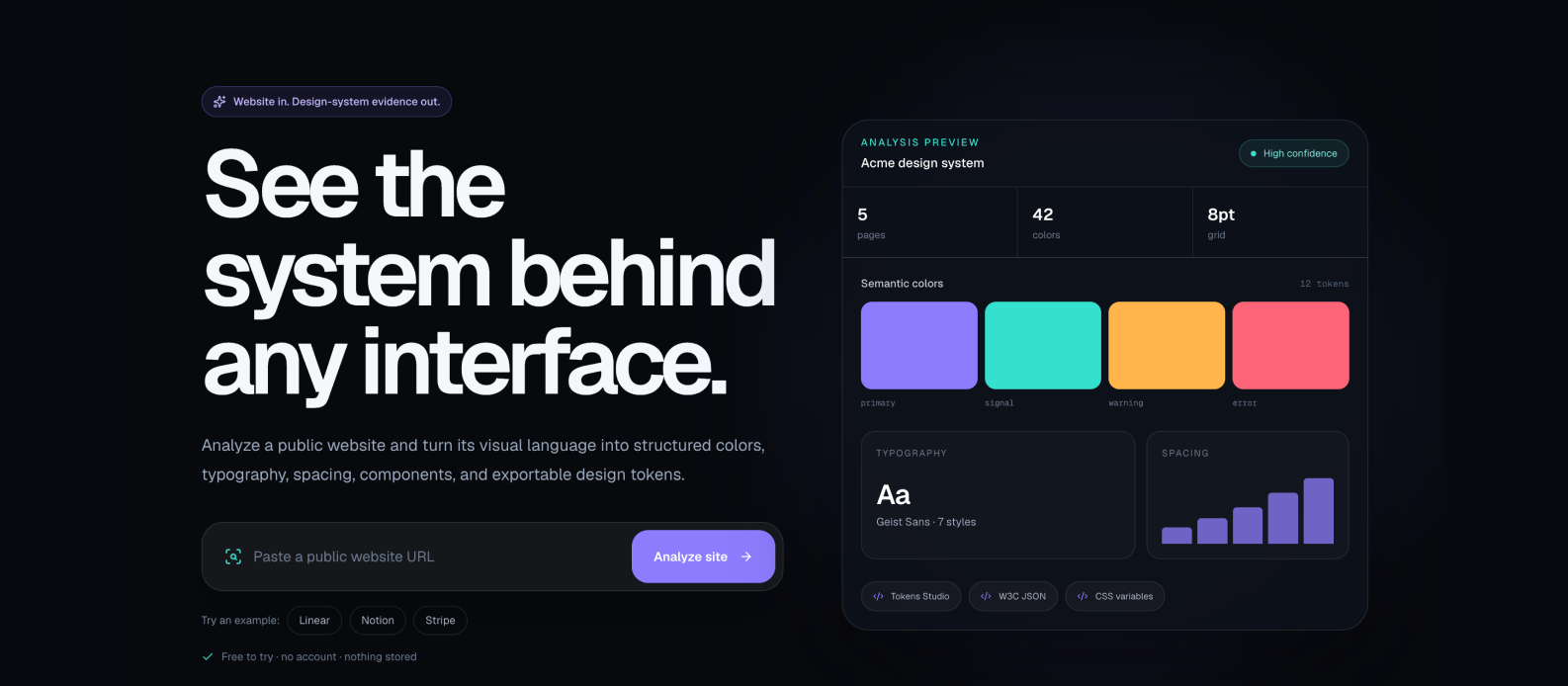
A working product that moves from one URL to an evidence-based design-system report.
Problem discovery
Designers regularly inspect other products to understand containers, spacing, typography, colors, components, and responsive patterns. The same manual work appears when creating client systems or auditing an existing product.
The observations are valuable, but they are difficult to organize, compare, and translate into reusable foundations. Existing systems also become inconsistent and outdated, turning every audit into another manual documentation exercise.
What if an interface could be analyzed for us, turning visual exploration into structured design-system evidence?
Reveal the patterns behind colors, type, spacing, layout, components, and responsive behavior.
Give designers and developers a structured foundation they can verify and refine.
Find recurring rules, gaps, one-off values, and areas that require human judgment.
Product method
The product preserves a clear distinction between what was observed in the interface and what was inferred or normalized. That makes the output useful without pretending automated analysis can replace design judgment.
Read rendered colors, typography, spacing, layout, radii, shadows, breakpoints, components, and states.
Compare representative pages to identify recurring patterns, relationships, and inconsistencies.
Organize observations into primitives, semantic roles, component tokens, and themes.
Separate observed values from inferred, merged, or normalized decisions.
Generate usable formats for Figma and development workflows.
Experience and system
The product begins with one field. Complexity is introduced progressively through live analysis feedback and a report organized around the questions designers are likely to ask next.
Pages crawled, analysis mode, findings, duration, and crawl-quality signals.
Semantic roles, frequency, usage, state connections, gradients, and copyable values.
Font families, hierarchy, sizes, line heights, grids, scales, radii, shadows, and layout patterns.
Detected patterns and states, Tokens Studio JSON, W3C DTCG JSON, and CSS variables.
Token architecture
Product decisions
The product is designed as a starting point for a designer—not an authoritative replacement for one.
Fallback roles are marked so inferred completeness is never confused with evidence from the site.
Page coverage and component usage help distinguish systemic patterns from one-off values.
Blocked headless crawls fall back to static analysis while the report communicates reduced confidence.
Exports connect the report to Figma and development workflows instead of trapping the result in a dashboard.
AI collaboration and iteration
I used AI as an implementation and exploration partner while retaining ownership of the problem, experience architecture, design-system logic, priorities, testing criteria, and final decisions. The repository credits Claude on implementation commits and records Vercel Agent contributions separately.
Multi-page crawl, rendered-style collection, relevance scoring, token generation, progress streaming, report and exports.
A live product review exposed two different landing experiences and leftover placeholder content. The product was consolidated around one clear journey.
Browser crawling, runtime limits, bot challenges, fallback behavior, semantic naming, and confidence reporting were refined through production checks.
Synthetic relevance tests, full-pipeline smoke tests, analytics, and a focused five-question early-tester survey created a foundation for continued learning.
Outcome and learning
Basic Designs shipped as a functioning tool capable of converting a public website into a layered design-token package. It demonstrates product discovery, information architecture, design systems, technical implementation, AI collaboration, testing, and delivery in one connected project.
Representative same-domain crawling.
Tokens Studio, W3C DTCG and CSS variables.
Live, testable, documented and instrumented.
Honest limitations